Set the Listening Gate
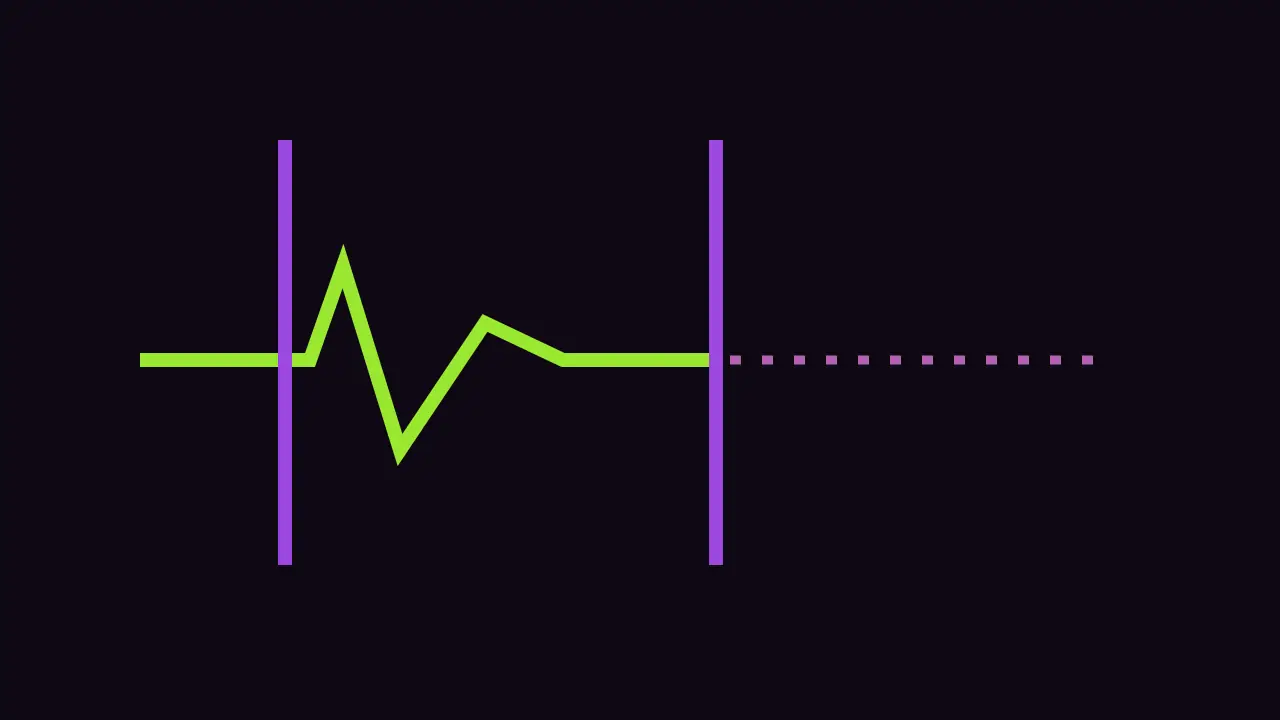
The first version of the service receiver printed each incoming trace as a complete call or a patch of noise. That split made the opening leg of Quiet Bearing easier to teach. It also hid what someone could learn from a partial signal. During the reset after a brief stop at the service hatch, the receiver could capture a useful leading edge and lose the rest. We needed to preserve that outcome without assigning it a direction the instrument could not establish.
Start the gate before the next change of angle
The receiver has a defined point in a rotation where it begins collecting a sample. Before that point, people can hear the ordinary room sounds and see when the instrument is ready. Once the gate starts, the receiver records how long it was listening and when a shape first crossed the screen. A player who leaves early retains the captured section. In the first design that section vanished, and reviewers interpreted the blank record as proof that there had been no signal.
The current readout gives a partial sample its own line. The line shows when it began and why it ended, and reserves the full direction label for a reading with enough support. A clipped mark can still direct a search. It can tell a player which part of a turn to watch on the next pass. The clip remains accessible while you move to the opposite station, making it possible to recall the moment without deciding what the entire pulse looked like.
Disconnect the gate from the transmission switch
The early control had one labelled toggle for turning the receiver on and sending a pulse. Reviewers treated the action as a request for another reading and had no reason to expect a transmitted burst. The current version keeps the listening state in a separate control. A player can start a gate and hear the ship as it is. There is also a distinct transmitter switch with a short explanation showing when it takes power away from the receiving branch.
This separation changes the working route. The nearest station can keep listening while the astronaut walks a short distance to check a panel. If they return and send a pulse during the next opportunity, the receiver marks the gap that follows. The previous trace remains visible, and the gap has a reason the player can see without repeating the transmission.
Compare similar starts under different conditions
Two sample starts can match and leave different amounts of information available. We give the player a view with the same time scale for both windows and a small label for the rotation. The first window may have cut off during a change of power. The second may be open long enough to show a change in contour. The readout uses the same weight for both observations because their shared portion still has value.
When no signal crosses the receiver, the display draws an unbroken baseline with the length of the listen. This was important to preserve after adding partial entries. Readers need a way to distinguish a quiet gate from an interrupted gate. Looking at only the reported arrival would make both situations appear equally empty.
Check the next decision
The current review ends by asking where the reader would wait for the next listen. Quiet Bearing introduces the rotating reference that makes this decision meaningful. The load window record explains what happens when a big draw changes the available time. A player can use a small piece of a previous reading to plan the next one. The recorded decision remains provisional until the receiver catches enough of the signal to refine it.