Read Both Panel Arrivals
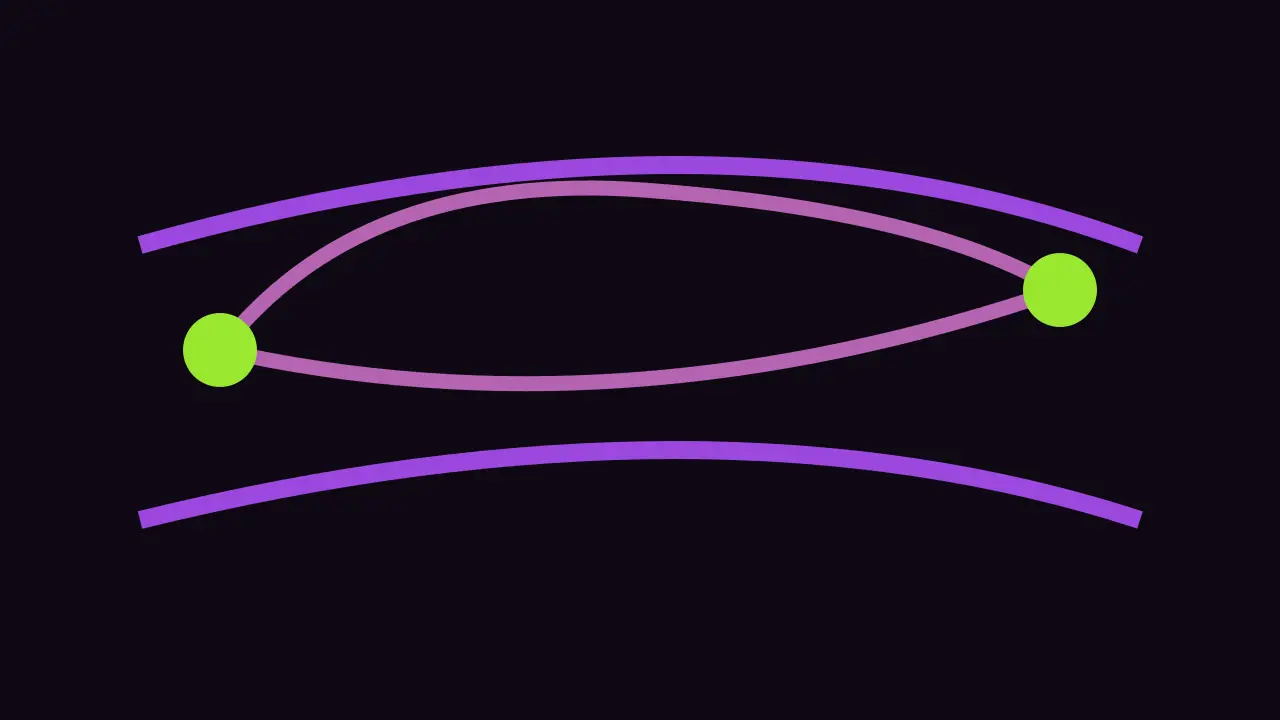
The first hull sensor model treated every spike as a touch at the closest rib. A pair of spikes produced a line in the crawlway diagram. We changed that representation after looking at a panel with more than one route between the same points. A single touch can produce a near reading and a later response on the other side of the seam. Showing each time before drawing the line makes that possibility visible.
Build a test surface the reader can inspect
Two sensors sit on raised mounts under a joined panel. From the left mount the panel looks continuous. On the right, a narrow reinforcing strip bends around a damaged edge. A pressure wave at the first mount can pass directly through the main sheet. It may also travel along the stronger strip and arrive later. Both paths remain plausible before you have seen the location of the reinforcing strip.
When the reader walks to the right mount the strip becomes visible. The geometry uses a separate contour from the dark insulation behind it. A thin bounced light puts the contour in view at the height where the astronaut can examine it. The corner of the sheet also stays visible so a close inspection does not hide the simplest direct path.
Give the clocks a common reference
As the prototype originally displayed them, both traces started at the point where each receiver woke up. That made a delayed arrival look like an earlier reading when its receiver took longer to establish the connection. The next version marks the point where the clocks have their first shared reading. A clip recorded before that point can still be opened. It is labelled as having its own reference and cannot supply a direct elapsed time until it is aligned.
The common reference also affects what we can ask of the player. If the two receivers have agreed on their zero, a small difference between arrivals becomes a useful number. You can compare it with an observed route along the seam or with the movement that somebody thinks they saw outside. When one receiver is missing, the recorded arrival remains a meaningful sound from a particular part of the ship. It cannot determine a shared interval alone.
Offer two paths without pretending to decide
The proposed interface lets the player inspect a short direct path and a longer path around the bend. Each path displays the points it would use. Selecting the long path leaves the original readings in place. A later observation can then replace the proposed line without losing the timing. When the drawing cannot reconcile the two measurements, the station preserves that disagreement in the record.
We tested an automatic warning light for the longer path. It suggested that this was the threat the player should prefer. The current revision uses the same marker for either route and shows its selected state only while the reader is inspecting it. The difference in the measurement does more work than the warning light did. Whether somebody should move closer to the seam depends on the power left and what the last intact sample shows.
Use the case again from the other branch
Borrowed Air’s panel scene offers another listening position before the hatch. A player can choose that station to compare the reflected reading with the first pair. The prototype keeps the contribution of the later position visible even if the original diagram looked convincing. The observation position note follows a related change to a bearing. It uses an obstruction a reader can see to explain a second direction. For the hull case, the visible seam is a physical reason to examine what the second spike represents before drawing a path to it.